
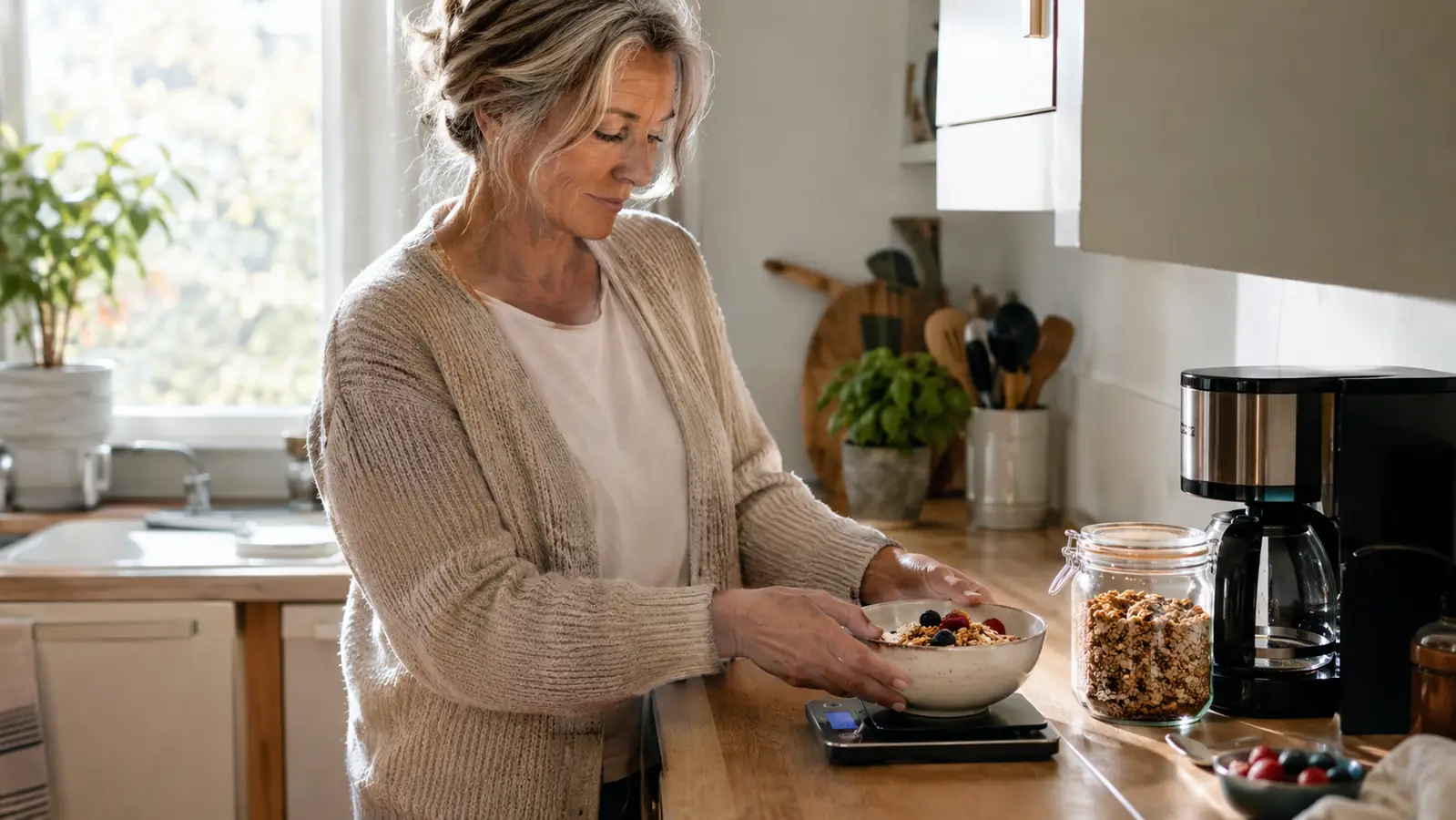
The serving size on the bag said half a cup. I scooped out what looked like half a cup, poured the milk, and sat down to my breakfast. It was not until I finally put the measuring cup on a scale that I learned I had been eating closer to a full cup of granola every morning for years. That is the honest reason I bought the Etekcity Digital Food Scale, and it is the same scale that has lived on my kitchen counter in Toledo ever since. I am not a nutritionist, and I am not here to hand you a meal plan. I am a retired dental office manager who decided at 56 that my numbers were creeping up and I needed to do something about it.
Measuring cups are fine for liquids you can see through, and they are useless for almost everything else. Shredded cheese settles. Flour compacts. A cup of oats scooped gently and a cup of oats pressed down are two different amounts of food, and your body does not care what the cup said. A scale reads the same amount every single time, because a gram is always a gram. If you are trying to eat reasonable portions without living on a spreadsheet, that consistency is the whole ballgame. When my doctor said my numbers were creeping up, portion size was the first thing I looked at, because it was the one thing I could change that week without buying anything new or learning a new skill. Here is the exact routine I use, in the order I use it.
The scale that fixed my morning granola
The Etekcity Digital Food Scale reads in grams and ounces up to 11 pounds, switches between five units, and shows the number on a backlit display you can read before coffee. It is the tool I use for every portion-size question in this guide.
Amazon Check Today's Price on Amazon →Step 1: Set the scale up and pick grams
The Etekcity arrives with two AAA batteries already installed, so there is no trip to the drawer for a screwdriver before you can use it. Set it on a flat, hard surface. I use the counter next to the coffee maker. A cutting board or a folded towel will flex under the weight and give you a reading that drifts, so hard and level is the rule. I also make sure nothing hangs over the edge, because a bowl that is half off the scale reads like a different weight. If the surface is not steady, the number will not be either, and you will start doubting the tool instead of the surface.
Before you weigh anything, decide on grams. The scale measures in five units: ounces, pounds, grams, fluid ounces, and milliliters. Grams are the ones to use for portioning because the numbers are small enough to be precise and the math is simple. The 2.4 by 1.1 inch backlit display is easy to read, which matters at 6:30 in the morning when I have not had my coffee yet. It is a counter scale with a mini footprint, so it takes up almost no room next to the toaster. Five units sounds like a lot, but you will settle into grams within a week and barely touch the others.
The included bowl is the detail I did not expect to care about. It flips up when you need it for cereal, berries, or anything that rolls, and it flips down flat for storage. That one feature is why mine does not live in a drawer. It stores in about two inches of cabinet space, so it is easy to put away and even easier to pull back out, and a tool you can reach is a tool you will use.
Step 2: Zero out the scale before the food goes on
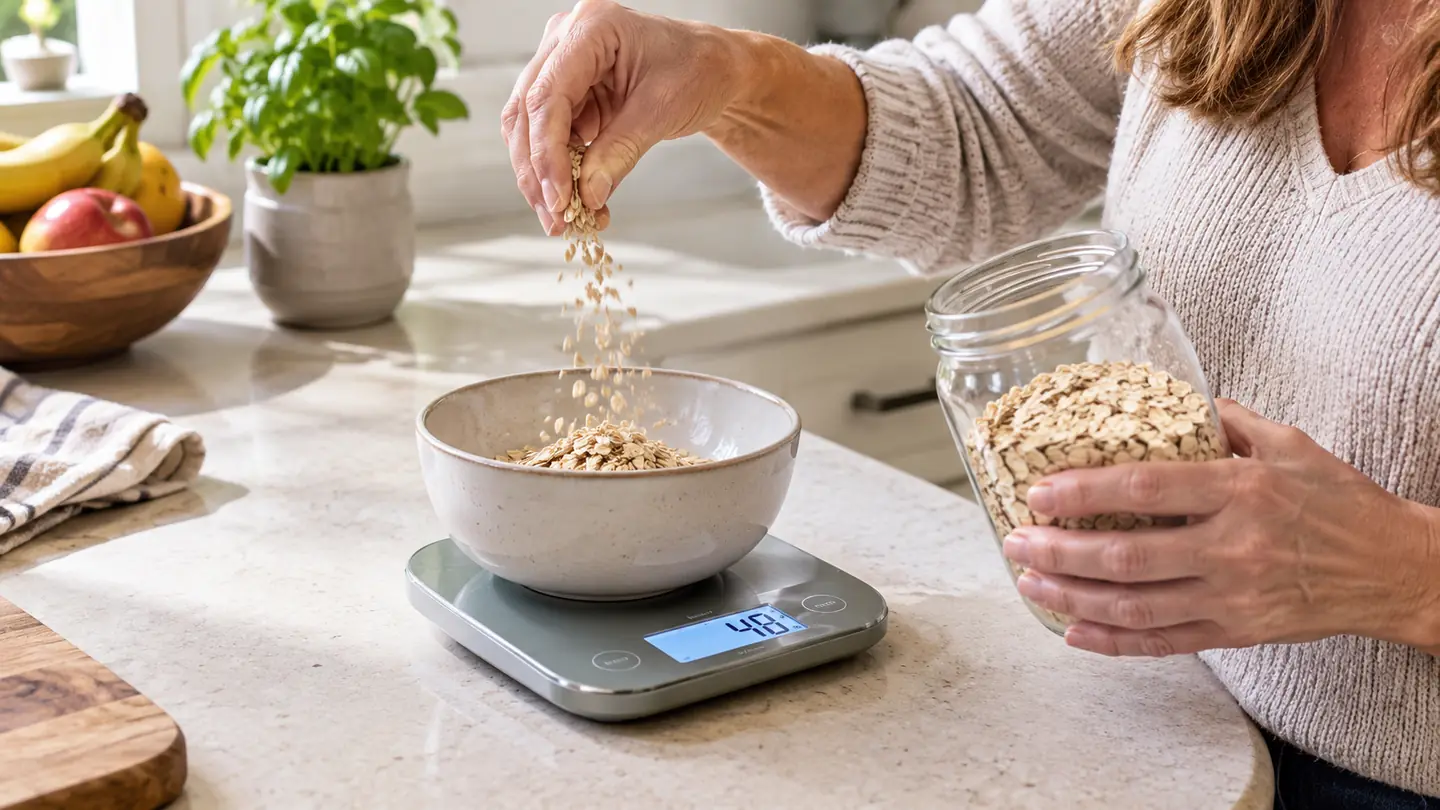
Put the bowl or plate on the scale first, then reset it to zero so you are weighing only the food. This is the step that makes the whole method work. If you weigh the bowl and the food together, you are subtracting the bowl in your head, and that is exactly the kind of mental math that stops working on a busy weeknight. Let the scale do the subtracting for you.
The routine takes four seconds. Bowl on the scale, zero it, add the food, read the number. I do it so often that my hands know the order, and that is the point. The less thinking a habit requires, the more likely you are to keep doing it when you are tired or hungry. The same approach works for the pot when I am cooking, and for the container I am packing lunch into.
Zeroing matters even more for sticky foods. When I weigh peanut butter, I put the jar on the scale, zero it, and then scoop out what I want. Whatever comes out of the jar shows up as the amount on the spoon, so I know the serving size before it ever touches my toast. I weigh peanut butter this way every morning now, and I have not washed a sticky measuring cup since. Same idea works for honey, syrup, or anything that would make a measuring cup a misery to wash.
Step 3: Learn what one serving actually looks like
Pick the one food you eat most often, and weigh a single serving once. My granola was the wake-up call. The bag said a serving was 40 grams. The half cup I had been scooping weighed 62 grams. That is one and a half servings every morning, which means I was eating the equivalent of an extra breakfast every two days without knowing it. No wonder my Saturday weigh-ins were not moving the way I expected. Weighing it took about ten seconds. That ten seconds is the whole reason my Saturday mornings look different now.
The Etekcity reads in 0.1 gram increments below 1000 grams, so it catches the small stuff too: a tablespoon of peanut butter, a serving of nuts, the cheese you grate over your eggs. Weigh those once, look at what they look like in your bowl, and your eye starts to recalibrate. You are not weighing everything forever. You are teaching yourself what a portion looks like, and that lesson sticks.
Do this for the five or six foods you eat most and you will start to notice it away from home. A restaurant portion of pasta stops looking normal. A hotel breakfast muffin stops looking like one serving. The scale does not have to come with you. Once your eye knows what 40 grams of granola looks like, your eye knows it everywhere. That is the real payoff of this whole routine: freedom from second-guessing.
Step 4: Portion a whole batch in one go
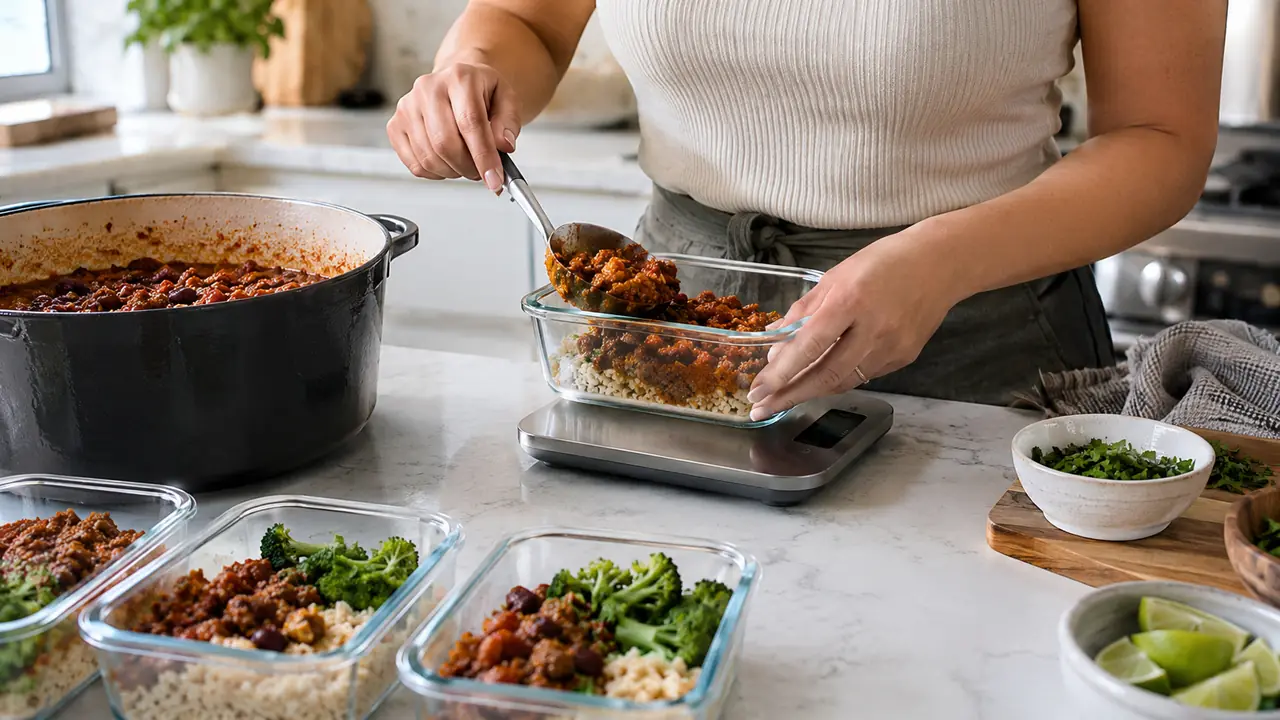
This is the step that saves my Sundays. I cook a big batch of something simple, usually chicken and rice or a pot of chili, and I portion it into lunch containers for the week. Put the pot on the scale, zero it, and note the total weight. Divide that number by how many lunches you want, then scoop that amount into each container. I write the serving weight on a piece of masking tape on the lid, so I do not have to remember it on Tuesday. Five lunches from one pot, and every container comes out the same.
Say the pot of chili weighs 2600 grams and you want five lunches. Each container gets 520 grams. That is the whole math problem. You are not measuring five separate portions with five separate cups that each pack differently. You are doing one division problem and then scooping until the number on the display is right. I leave the pot on the scale for the whole scooping, so I can adjust each container before I move on.
A full pot of soup or chili is heavy, and the Etekcity handles up to 11 pounds, which is plenty for a week of lunches. Above 1000 grams the scale reads in 1 gram steps, which is plenty of precision for a pot of chili. The scale itself is small and light, about 1.3 pounds, so it does not take over the counter. When I am done, the bowl flips down and the whole thing tucks into the back of the cabinet until Sunday comes back around.
Step 5: Weigh the tricky foods, not just the easy ones
The foods that get people are the ones measuring cups handle worst: peanut butter, shredded cheese, pasta, rice, honey. A cup of shredded cheese can vary by 30 percent depending on how it settles in the cup, and a cup of pasta can vary by even more. Weigh those foods at least once so you know what your usual serving actually is. You might be surprised which ones are bigger than you thought and which ones are smaller. For me it was cereal that was bigger and olive oil that was smaller. Both were useful to know.
For liquids, the scale switches to fluid ounces or milliliters, so you can pour straight into the bowl on the scale and read the amount without washing an extra measuring cup. The stainless steel surface wipes clean in a second, which matters when you are weighing something sticky at 7 a.m. The bowl catches drips and splashes that a flat scale would leave on the counter. I use the milliliter setting for the milk in my coffee and the fluid ounce setting for salad dressing, and both are right there on the same scale.
Baking is where the scale really earns its place, and the Etekcity lists food and baking as its intended uses. Flour is the worst offender with measuring cups. Weighing it in grams is the difference between a recipe that works the same way every time and a recipe that works only when you happen to scoop it the same way twice. If you bake at all, this alone is worth having it on the counter.
What Else Helps
Three habits made the scale stick for me. First, I leave it on the counter, not in the drawer. If I have to dig it out, I will not use it. Second, I weighed my usual foods once and saved the numbers in a note on my phone, so I do not have to re-learn them every week. Third, I weigh my evening snack, because that is the time of day I used to eat without looking. My husband Rick still snacks in the evening, and I am not here to police his bowl of pretzels. I just weigh mine.
I keep a simple food log on my phone and weigh in once a week on Saturday morning. The scale is one tool in that routine, not the whole routine. The walking I do with Biscuit, our beagle mix, matters as much as anything I weigh, and the short strength sessions in the living room matter too. Portioning just makes sure I am not undoing all of that work before dinner. The Saturday weigh-in keeps me honest without turning into a daily obsession, and the food log takes about two minutes a day.
The first week is the hardest, because everything you thought you knew about your portions gets corrected at once. It is also the most useful week, because those corrections are exactly the information you were missing. After that, the scale mostly just confirms what your eye already knows, and you will reach for it out of habit, not out of discipline.
One more thing, and it is important. If you have a health condition, or you are changing what you eat for a medical reason, check with your doctor before you overhaul anything. This is not medical advice. It is just a way to see what is actually on your plate, and seeing it is the first step to doing something about it.
The half cup of granola I called a serving weighed 62 grams. The bag said 40. I had been eating one and a half breakfasts every morning without knowing it.
Start with the scale that started it for me
The Etekcity Digital Food Scale is the same one that has been on my counter since I started weighing portions. It reads in grams and ounces, handles up to 11 pounds, and comes with a bowl that flips down for storage.
Amazon Check Today's Price on Amazon →