If you are trying to be more careful about portions, you have probably stood in your kitchen with a measuring cup in one hand and wondered if you were doing this whole thing wrong. I did that for a year. I scooped oatmeal, leveled off peanut butter, and told myself a cup of this or a half cup of that was close enough. Then I started using the Etekcity Digital Food Scale, and the measuring cups moved to the back of the cabinet.
Back in February, I was doing my usual Sunday prep and I scooped what I thought was a half cup of oats into my bowl. Something made me put the bowl on the Etekcity scale before I added the milk. It read 62 grams. I had been logging 40 grams. That is the difference between a breakfast I thought was 150 calories and one that was closer to 220, and I had been eating that extra 70 calories every single morning for months. It does not sound like much, but it is about 25,000 calories over a year, which is part of why the number on the scale at my doctor's office had been creeping up.
I am Teresa, by the way. I am 58, I live in Toledo, Ohio, and I spent thirty years as a dental office manager before I retired. I am not a nutritionist and I am not a coach. I am just someone who decided, after a checkup two years ago, that I wanted my portions to match what I thought I was eating. My husband Rick still snacks in the evening without weighing anything, and my dog Biscuit is the reason I walk twice a day in every kind of Ohio weather. The scale was not a dramatic change. It was a quiet one.
The short answer: the Etekcity scale is more accurate, faster for most foods, and easier to clean than a set of measuring cups. But measuring cups still win for liquids you want to eyeball, for people who hate reading a display, and for anyone who does not want to change what already works. I have used both for the better part of a year, and I would not give up either one. Here is the honest breakdown.
| Etekcity Digital Food Scale | Measuring cups | |
|---|---|---|
| Accuracy | Reads down to 0.1 g under 1000 g and 1 g from 1000 to 5000 g, so a serving of oats or chicken comes out the same every time | Depends on how you scoop, level, and squint at the line; a cup of flour can vary by 20 to 30 percent |
| Speed for dry ingredients | Put the bowl on the scale, add ingredients one at a time, read the number | Scoop, level, and repeat for every single ingredient |
| Liquids | Weighs in ounces, pounds, grams, fluid ounces and milliliters, but you still pour into the bowl | A liquid measuring cup with a spout is the most natural way to measure milk, water or broth |
| Cleanup | Wipe the stainless steel top and wash the flip-up bowl in the sink | Wash measuring cups and spoons by hand or stack them in the dishwasher |
| Learning curve | Takes one or two meals to get used to weighing instead of scooping | You already know how to use them; there is nothing new to learn |
| Best for | Portion control, meal prep, baking, and anyone logging food | Quick pours, kids helping in the kitchen, and people who prefer not to weigh anything |
Where the Etekcity Scale Wins
The Etekcity scale wins on accuracy, and accuracy is the whole point of portion control. Measuring cups measure volume, not weight, and volume lies. A cup of oats scooped lightly weighs less than a cup of oats packed down. A cup of shredded cheese depends entirely on how it lands in the cup. When I log food on my phone, the app asks for grams, and the scale gives me grams. Measuring cups give me a guess. The difference is not subtle once you start looking.
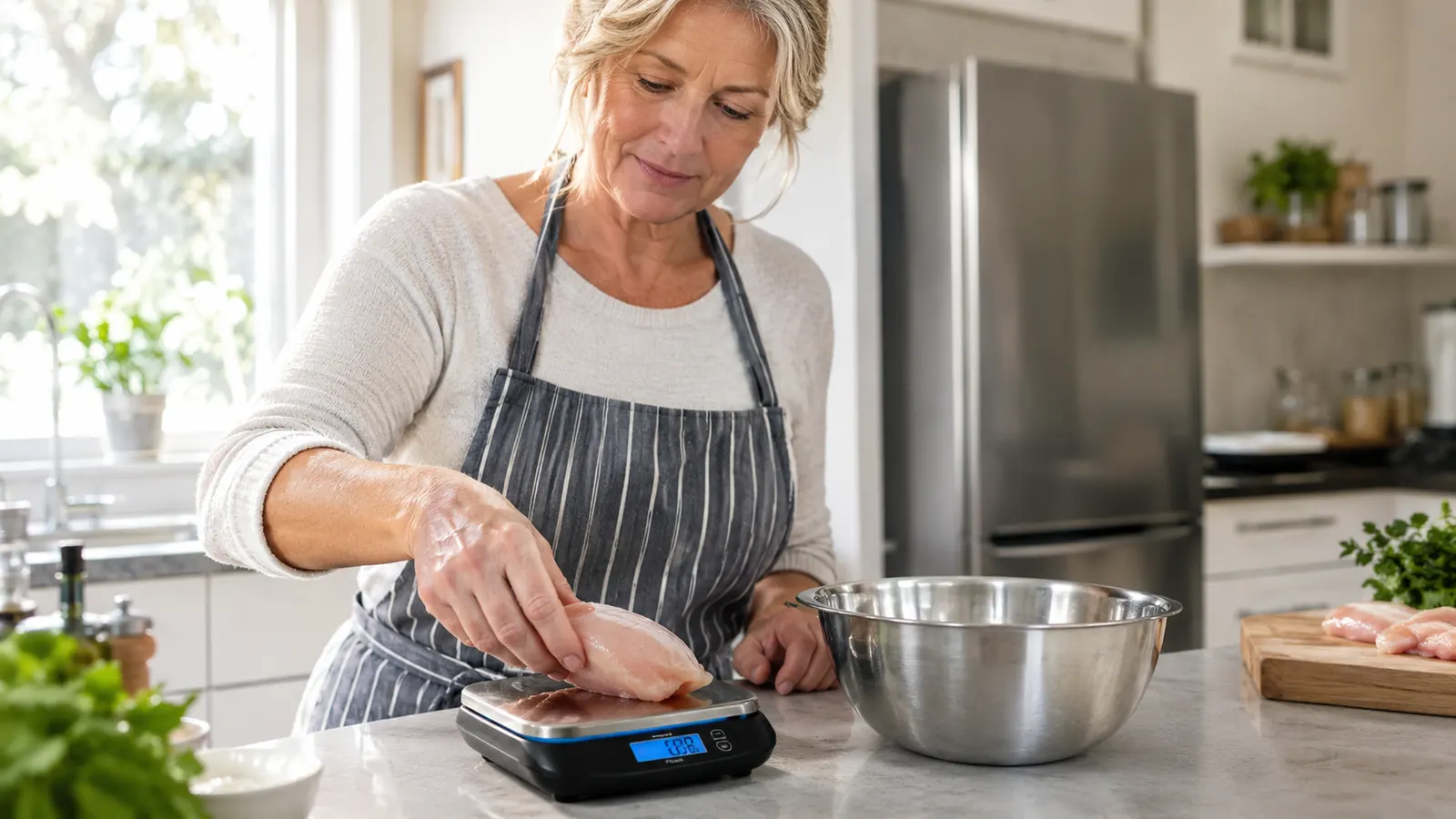
It also wins on speed once you learn the rhythm. I put my bowl on the scale, wait for the number to settle, add the chicken, read the number, reset the scale, add the rice, and read again. The backlit LCD display is easy to read even in my dim corner cabinet area, and the flip-up bowl means I can weigh something small like nuts or shredded cheese without chasing pieces across the counter. Cleanup is a wipe and a rinse, not a stack of cups and spoons.
Last Tuesday I made chicken and rice for lunches. I put the bowl on the scale and it read 0 grams. I added a 6.4 ounce chicken breast, which is 182 grams. Then I reset the scale, added 150 grams of cooked rice, and reset it again for 85 grams of broccoli. The whole thing took less than two minutes, and every container in my fridge had the exact same amount. With measuring cups, I would have scooped rice into a cup, packed it, leveled it, and still not known if the cup was the same as yesterday's cup.
The scale also handles the foods that measuring cups are worst at. Peanut butter is the one I used to fight with. A half cup of peanut butter depends on whether you pack it, whether it is warm, and how much sticks to the spoon. On the scale, I just put a small bowl on it, reset it, and scoop peanut butter until it reads 32 grams. The flip-up bowl is perfect for this because it catches the stray bits. Nuts, shredded cheese, and chopped vegetables all work the same way.
I should be clear that the Etekcity is not magic. It is a tool. It has a backlit LCD display that I can read at 5:30 in the morning, it weighs up to 5 kilograms, and it reads in 0.1 gram increments under 1000 grams. That precision is what makes the consistency possible. But you still have to look at the number and decide what to do with it.
The other thing I did not expect is how much the scale helped me learn what portions actually look like. I used to think a serving of chicken was about the size of a deck of cards, which is what every article says. But when I weighed it, the chicken breast I normally ate was 6.2 ounces, not the 3 ounces I had in my head. Seeing the number did not make me feel bad. It just made me realize that my idea of a portion and the actual portion were two different things. That alone was worth the price of the scale.
The scale that made my measuring cups jealous
The Etekcity Digital Food Scale reads in grams and ounces, handles up to 5 kg, and has a backlit display that is easy to read first thing in the morning. It has a flip-up bowl for small foods and runs on two included AAA batteries, so it is ready the day it arrives. If you are logging food or just want the same portion every day, this is the one I reach for.
Amazon Check Today's Price on Amazon →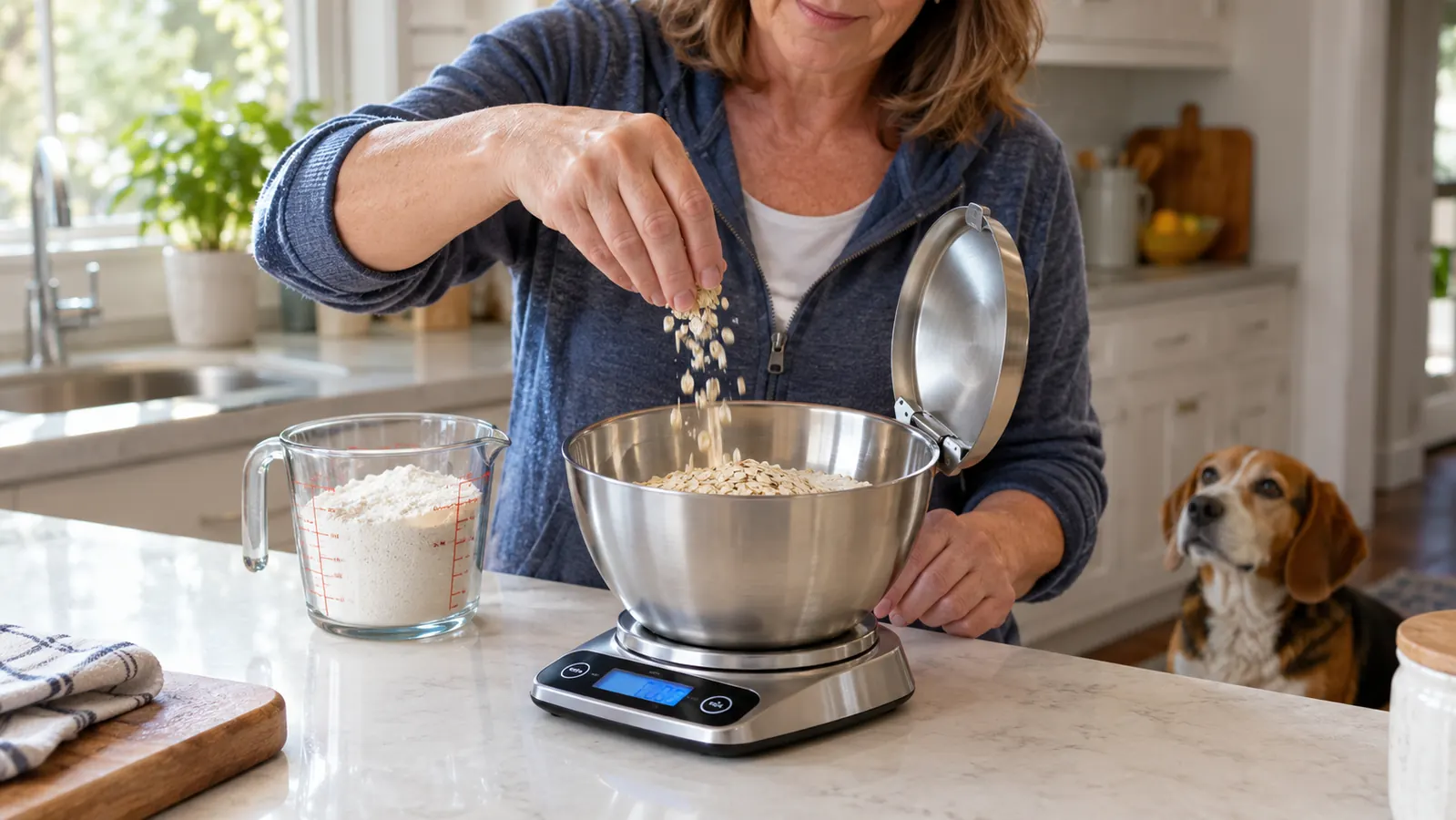
Where Measuring Cups Win
Measuring cups win at liquids. I still grab a liquid measuring cup for milk, water, and broth because pouring to a line is faster than pouring into a bowl on a scale. The Etekcity scale does measure fluid ounces and milliliters, so it can do the job, but a cup with a spout is simply the natural tool for a splash of milk in your coffee or a cup of broth in a pot of soup.
They also win on zero learning curve. My husband Rick can find a measuring cup in the dark. He does not want to learn how to use a scale, and he does not need to weigh his evening snack. If you are the only person in the house who cares about portions, the measuring cups will still be there for everyone else. And if you bake with a recipe written in cups, you can absolutely keep using cups and just weigh the ingredients you tend to overdo.
I still use measuring cups for a few specific jobs. When I make my grandmother's pancake recipe, it is written in cups and it comes out right every time. I am not about to rewrite a recipe that has worked for fifty years. I also grab a liquid measuring cup when I am adding water to the dog's food or broth to a pot of soup, because the spout makes it a one-hand job. The scale can measure milliliters, but it cannot pour for me.
There is also the matter of other people. Rick does not weigh his evening popcorn, and he is not going to start. If I made him use the scale, he would just stop helping in the kitchen. Measuring cups let him make his own snacks without a lesson. That is worth something. A tool that only one person will use is a tool that only does half its job.
And honestly, measuring cups are forgiving. If you are making a big pot of chili, a slightly heaping cup of beans is not going to ruin anything. The scale is the better tool when the number matters, but not every meal needs a number. Some meals just need to get on the table.
I will also say that measuring cups are better for cooking with kids. A child can scoop flour into a cup and level it with a knife without much instruction. A scale would be one more thing to explain, and it would not be as much fun. If you cook with children, measuring cups are the friendlier tool.
Who Should Buy Which
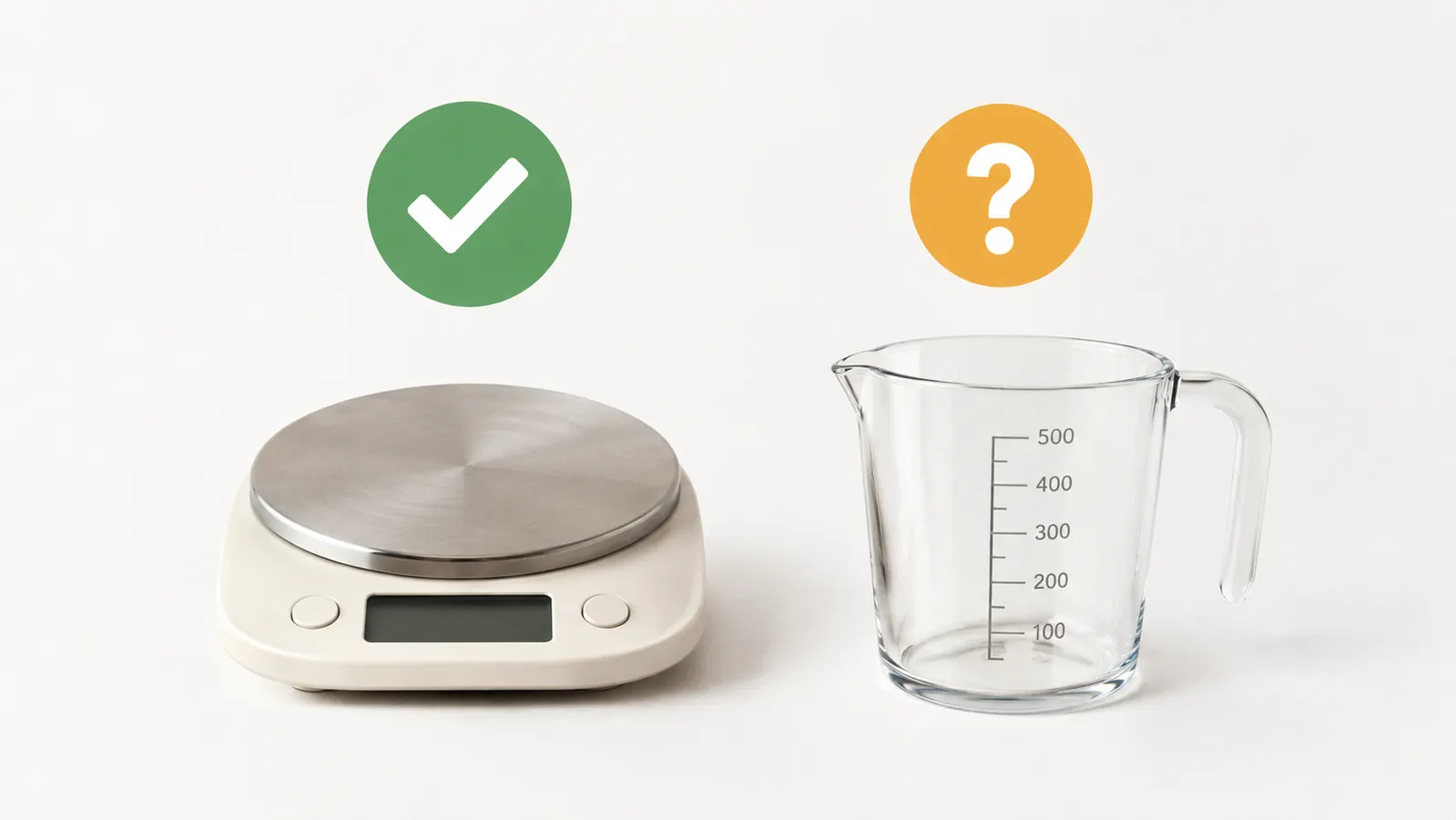
Buy the Etekcity Digital Food Scale if you are logging food, prepping lunches on Sunday, or trying to make your portions consistent day to day. It pays for itself in the first week of not guessing. Buy or keep measuring cups if you mostly measure liquids, if you cook from cup-based recipes, or if you simply do not want one more gadget on the counter. Most homes, including mine, end up using both: the scale for anything where the number matters, the cups for everything else.
My practical advice: start with the scale for the foods you eat most often, especially protein, oats, rice, and peanut butter. Keep the measuring cups for liquids and for anyone else in the house. You do not have to throw anything away. You are just adding a better tool for the job you care about most.
If you are on the fence, here is a simple test. For the next three days, weigh the food you eat most often: your morning oats, your lunch chicken, your evening rice. Write down the grams. Then go back and measure the same foods with your measuring cups and write down the cups. I think you will see the difference immediately. The day I did that test, my oats were 40 percent heavier than I thought. That is not a judgment, it is just information, and information is the whole point.
I also want to say something about the Sunday meal prep example, because that is where the scale earns its place in my kitchen. Every Sunday I cook a big batch of chicken, rice, and roasted vegetables. I divide it into five containers for the week. With measuring cups, I would portion by eye and the containers would be uneven. With the scale, I put each container on the scale and add food until it hits the same number. Every lunch is the same size, which means every lunch has the same calories, which means I am not playing a guessing game on Wednesday afternoon when I am hungry.
One last thing: you do not need to be perfect. I still have days where I eat without weighing anything, and that is fine. The scale is not a punishment. It is a way to learn what a portion actually looks like, and after a few months you will start to recognize it by sight. But for the days when I want to be sure, the Etekcity is the tool I trust.
If you are still not sure, consider what you actually cook. If you make a lot of soups, stews, and casseroles, measuring cups are fine. If you eat a lot of single portions of meat, grains, and nut butters, the scale will do more for you. I keep both in my kitchen, but the scale is the one I reach for when I am logging food, and the cups are the ones I reach for when I am just making dinner.
Measuring cups measure volume, and volume lies. The scale gives me the same serving every single day, and that consistency is what made the difference for me.
Start with the food you eat most
The Etekcity Digital Food Scale weighs up to 11 lb / 5 kg with a backlit display and a flip-up bowl. The included batteries mean you can start weighing the moment the box opens. It is the tool I use every morning, and it is the one I would recommend to anyone starting to take portions seriously.
Amazon Check Today's Price on Amazon →