
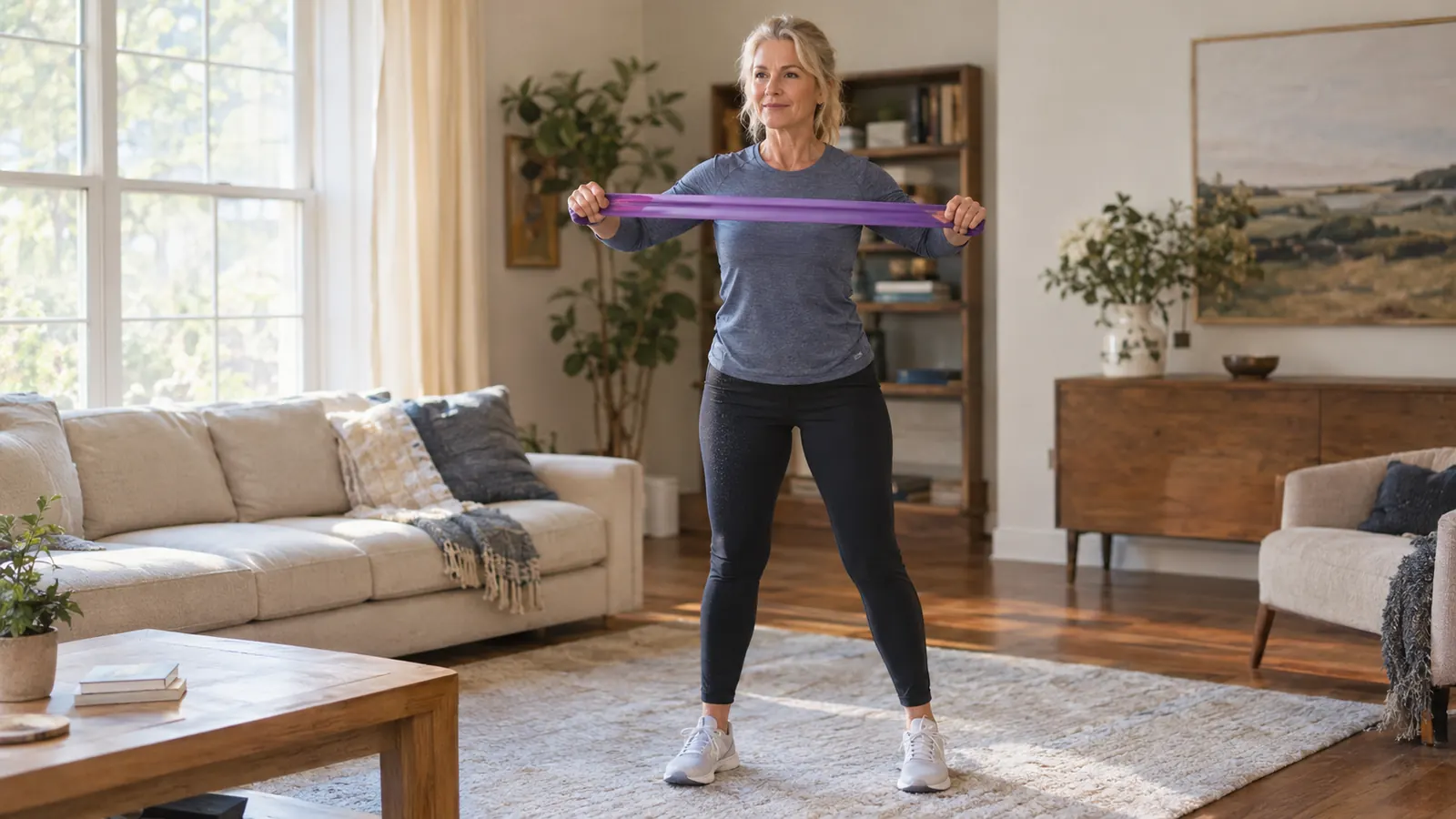
I spent most of my adult life assuming strength training meant a gym membership, a spotter, and a rack of iron I had no idea how to use. So I didn't do it. I walked, I watched my portions, and I told myself that was enough. Then at 56, after a checkup where my doctor said my numbers were creeping up, I decided to get serious. The problem was that I still had zero interest in a gym. That is when a friend handed me her set of Fit Simplify Resistance Loop Exercise Bands and told me to just start with the lightest one.
Two years later, I am still doing short strength sessions in my living room in Toledo, and the Fit Simplify bands are still the main tool I reach for. If you have been putting off strength training because it feels complicated, expensive, or intimidating, this guide is for you. It is the exact five-step process I used to go from never touching a band to having a routine I actually stick with.
The only equipment you need is sitting in this box
Fit Simplify Resistance Loop Exercise Bands come as a set of five resistance levels, plus an instruction booklet and a carry bag. No dumbbell rack, no gym floor, no assembly. If you are ready to start strength training at home today, this is the set to start with.
Amazon Check Today's Price on Amazon →Step 1: Clear a small space and set a tiny goal
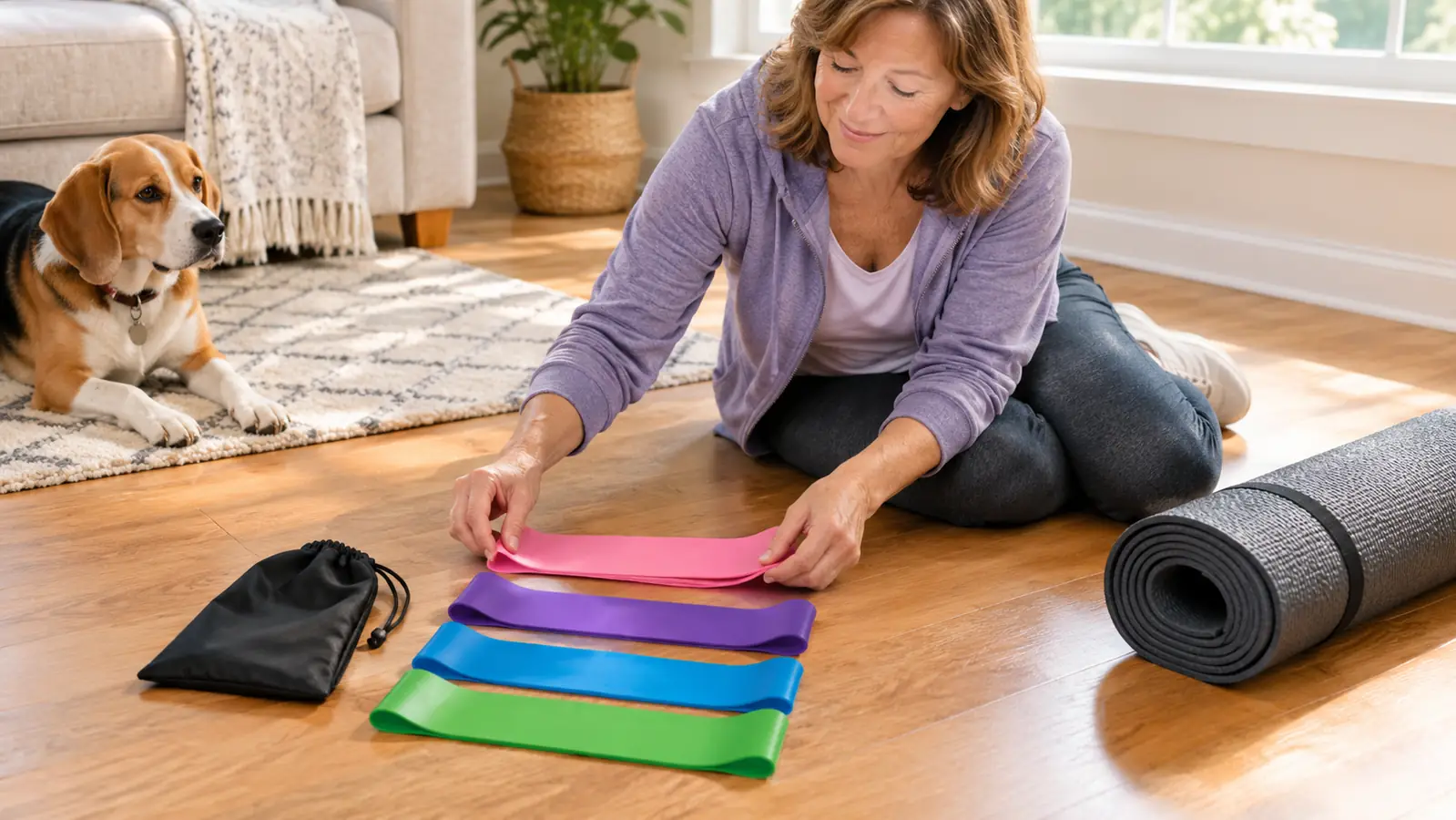
You do not need a home gym. You need about six feet of floor where you will not trip over the dog. For me that is the living room rug after I push the coffee table aside. I do my sessions while Biscuit, my 7-year-old beagle mix, naps on the couch. That is the whole setup.
Set a goal so small it feels almost silly. Mine was: twice a week, ten minutes, one exercise. Not a 45-minute workout program. Ten minutes. That goal came from a failure. In my mid-40s I bought a workout DVD and told myself I would do it every morning. I made it through the warm-up twice, then the DVD went into a drawer and I did not think about strength training again for a decade. This time I chose a goal I could not fail. If I did one exercise for ten minutes on a Tuesday and a Friday, I had met my goal. Some weeks I did exactly that and nothing more, and it still counted. When the goal is that small, you stop negotiating with yourself. You just do it. Once ten minutes became routine, I added a few minutes at a time. The routine is what matters, and a small routine you keep beats an ambitious one you abandon by February.
Pick a time of day and guard it. I do my sessions in the morning before my first walk with Biscuit, because I learned that if I wait until evening, Rick is making popcorn and I am suddenly too tired. Same time, same spot, every week. That consistency did more for me than any particular exercise ever did.
Step 2: Learn the five bands before you use them
The Fit Simplify set comes with five loop bands in five resistance levels, from extra light to heavy. The bands are latex loops, about 12 inches long and 3 inches wide, and a quarter inch thick. The included instruction booklet shows dozens of illustrated exercises, which is how I learned most of what I know.
Start with the lightest band you own. I started with the extra light band for almost everything, even though I was tempted to grab a heavier one to feel like I was working harder. The point of the first few weeks is not to prove anything. It is to teach your body the movement patterns and to give your tendons time to catch up. With bands, the resistance builds as you stretch them, so a light band still gives you a challenge at the end of the movement.
Keep the carry bag on the floor next to your mat. The included carry bag is small and light, and it keeps all five bands plus the booklet in one place. The first afternoon I opened the bag, I laid all five bands side by side on the rug and spent a few minutes just stretching each one between my hands. The extra light band stretched easily. The heaviest one barely moved. That five-minute test taught me more than any article I had read, because I could feel exactly where the progression would come from. I also wrote the date on a sticky note and stuck it to the booklet cover, so I would know how long I had been at it. That matters more than you would think. When the bands live in a bag in the living room, the workout lives in the living room too. If they were buried in a closet, I would have quit in the first month.
Step 3: Run through the five foundational moves
These are the five exercises I still build every session around. They cover the major muscle groups without needing a single piece of equipment beyond the bands. Do them slowly and with control. If you cannot finish the set without the band snapping loose or your form falling apart, switch to a lighter band. That is not failure. That is information.
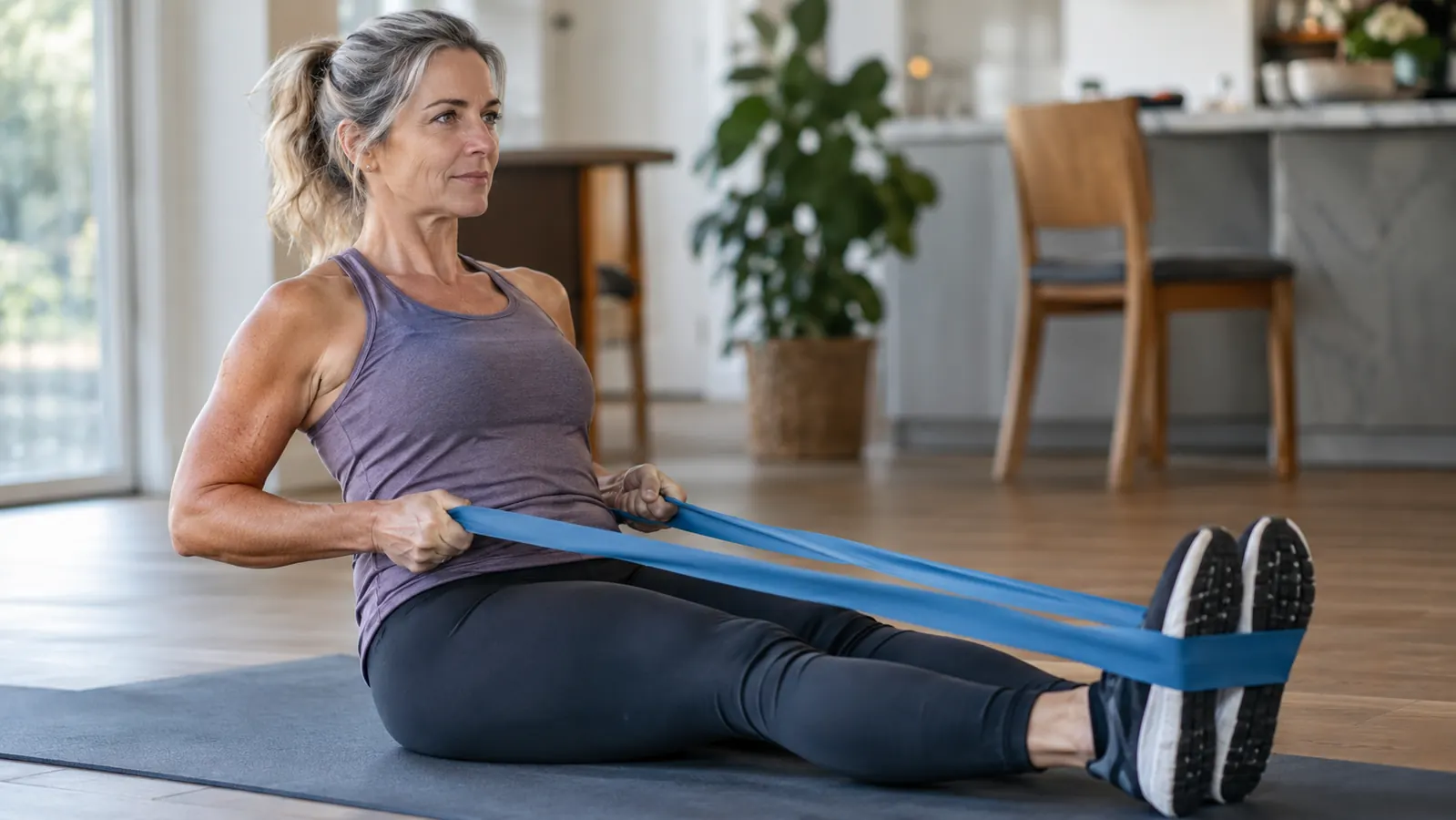
Seated row. Sit on the floor with your legs extended, loop the band around the soles of your feet, and pull the ends of the band toward your waist, squeezing your shoulder blades. This was the first exercise I could feel working, and it is still my favorite. Bicep curl. Stand on the middle of the band, hold one end in each hand, and curl your palms toward your shoulders, keeping your elbows pinned to your sides. Overhead press. Stand on the band, bring the ends up to your shoulders, and press them overhead until your arms are straight. Shoulder stretch. Hold the band behind your back with both hands and gently lift. This one loosens me up before I head out for my walk. Squat with band. Stand on the band with your feet hip-width apart, hold the ends at your shoulders, and sit back into a squat, then push through your heels to stand.
Start with one set of eight to ten slow reps of each move. My first session, I could only manage six seated rows before my arms started shaking, so I stopped there. The next week I got through eight. By the end of the first month I could do ten, and I added a second set. I remember the exact day, a rainy Tuesday, because I had to text Rick to come see that I had finished all ten without stopping. That slow progress was the point. If I had started with the heaviest band and tried to force ten reps, I would have hurt something and quit. Add a second set when the first set stops feeling hard. That is the whole progression system. You do not need an app, a chart, or a complicated schedule. You need to do the moves, rest a day between sessions, and add a little when your body tells you it is ready.
Step 4: Build your routine in five-minute blocks
Here is the structure that finally stuck for me after years of false starts: five minutes of the exercises above, three times a week, for the first month. That is fifteen minutes a week. It sounds like nothing, and that is exactly why it worked. I was never too tired, never too busy, never dreading it. I put a T on the kitchen calendar for Tuesday and an F for Friday, and when a session was done I drew a line through the letter. Watching those lines add up became its own small reward. By the end of the first month, the calendar showed eight finished sessions and I did not need the letters anymore.
After a month, I added a second five-minute block on the same days, doing the exercises I liked least first. That trick matters. If you save the exercise you dread for the end, you will skip it. If you do it first, the rest of the session feels easy. I still do the seated row first because it is the one that makes me feel the strongest.
The resistance band set supports this kind of gradual building better than almost anything else I have tried. Because the bands are light and portable, I can do a single exercise on the porch while Biscuit sniffs the yard, or five minutes in the living room before dinner. The workout shrinks to fit the day, instead of the day having to stretch to fit the workout.
Step 5: Increase resistance only when the movement gets easy
The Fit Simplify set gives you five resistance levels for a reason. You are supposed to move through them over time. The rule I use: when I can complete all my sets and reps with the current band and still feel like I could do a few more, I move up one level. Not when a certain number of weeks has passed. When the movement itself tells me it is time.
I am a slow progressor and I am fine with that. Two years in, I use the medium bands for most upper body moves and the heavier ones for rows and squats. The extra light band still comes out for shoulder work and for easier days. Last fall, I noticed the medium band no longer felt like work for bicep curls, so I switched to the heavy band for that one move and kept the medium for everything else. It took about six weeks before the new band felt normal, and I only moved up because the movement had gotten easy, not because a calendar told me to. Having all five levels in one set means I never have to buy a separate band when I outgrow one. I just reach for the next level in the bag.
One honest note: the bands are made of latex. If you have a latex allergy, this is not the set for you, and you should talk to your doctor about alternatives before you buy. For everyone else, the latex is what gives the bands their stretch and their grip. I have had my set for two years and the bands still snap back like the day I got them. Before every session I run the band through my fingers once, checking for any rough spot, because a small nick in latex can turn into a snap mid-movement.
What Else Helps
The bands do the work, but a few small things make the routine easier to keep. A yoga mat or any padded surface protects your knees on floor moves. A water bottle within arm's reach means you do not have to get up mid-session. And a simple weekly note in your phone, the kind I already kept for my food log, helps you see the pattern: which days you trained, which band you used, how the last rep felt.
I also pair my strength sessions with the walking I already do with Biscuit, twice a day in every kind of Ohio weather. The two habits support each other. Walking gets me outside, and the strength work gives me something to do on days the weather keeps us in. That is the combination I have stuck with over the last two years, slowly and steadily, with my doctor's okay.
The goal was never a perfect workout. The goal was a ten-minute session I would actually do twice a week, and the Fit Simplify bands are the reason I am still doing it two years later.
Start with the set that makes it easy to begin
Five resistance levels, an illustrated instruction booklet, and a carry bag that lets you take your workout anywhere. That is everything I needed to go from never lifting a weight to two years of consistent home strength training.
Amazon Check Today's Price on Amazon →